
Testing method
How We Test Transforming Robot Toys for Quality and Value
Our transforming robot toy quality test covers packaging, weight, 20 transformations, five poses, paint wear, a carpet drop and value scoring.
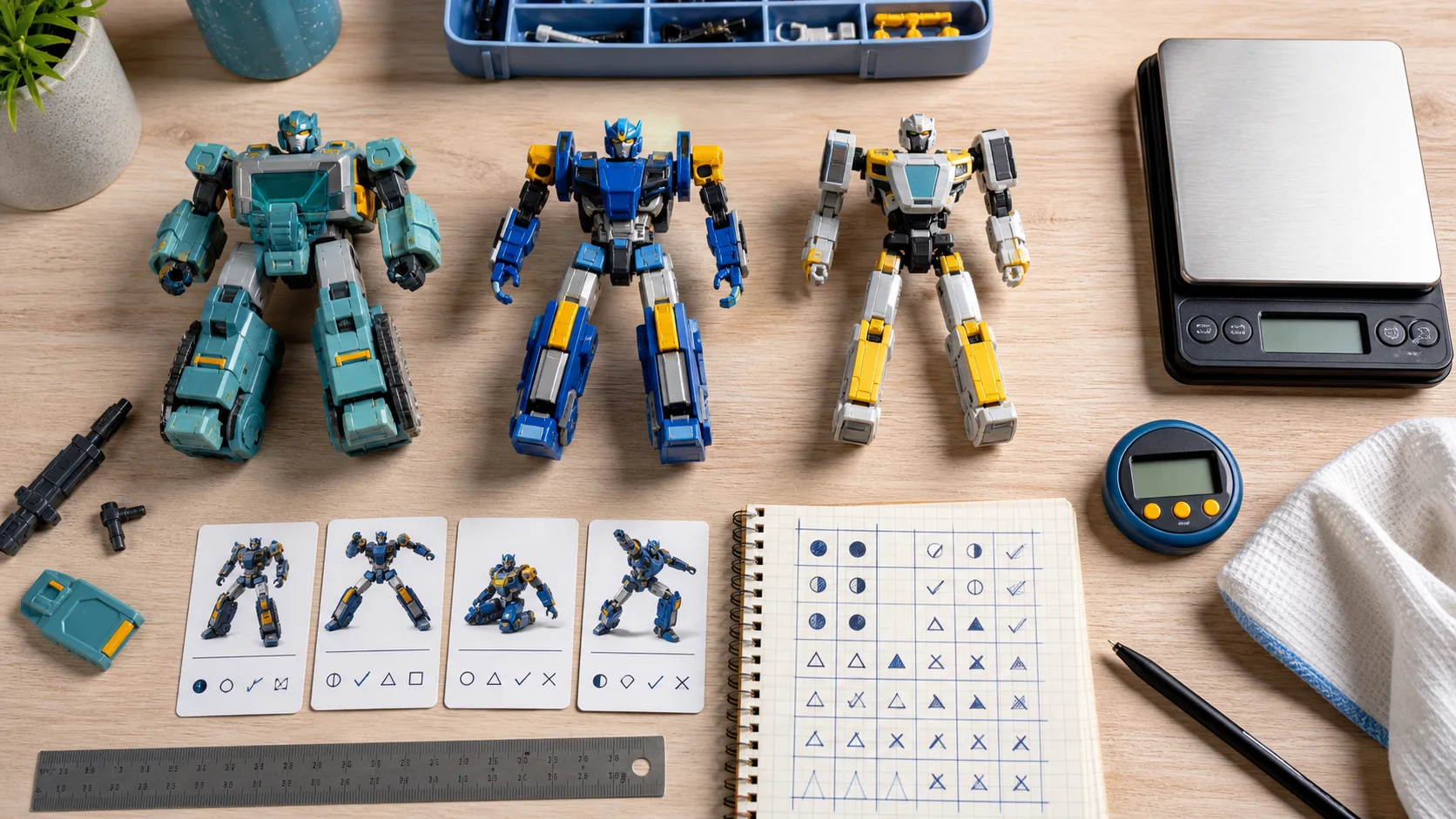
A transforming robot can feel brilliant for five minutes and disappointing by day five. Our transforming robot toy quality test is built around that gap. We record the first confusing transformation, repeat it 20 times, test five poses, inspect paint and joints, and finish with a low carpet drop. The method is simple enough to understand and strict enough to expose where a bargain earns—or loses—its price.
The question we are chasing: which problem appears first—frustration, looseness or damage? Our three budget samples begin at similar prices, but the test may send them in very different directions.
This protocol powers our knockoff Transformers review preview and sits inside the broader Leo Toy Hunt review standard.
The test bench
We use a digital scale, ruler or caliper, phone timer, dry white cotton cloth, fixed camera, flat table, carpeted test area, the supplied instructions and a test record for each sample.
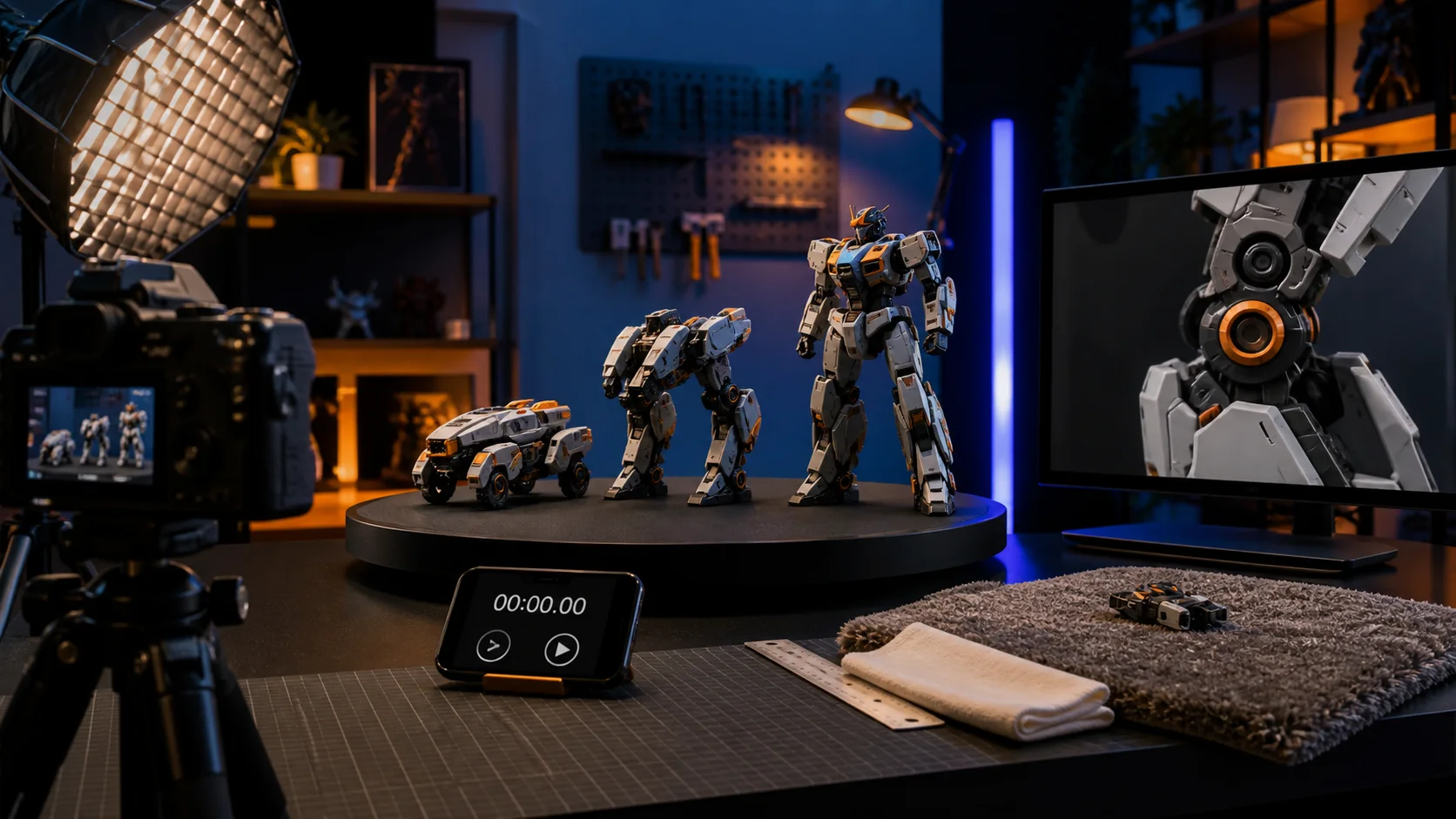
 Editorial illustration of the test setup. Final reviews will replace illustrative details with first-hand photographs of the purchased samples.
We do not use appearance, smell or a home chemical kit to declare that a plastic is safe. Home observations can flag a concern; they cannot replace laboratory testing.
1. Packaging and identity record
Before opening the box, we photograph every side and record:
- product, series and model number;
- manufacturer and address;
- stated material and age grade;
- warnings and claimed license;
- instructions and included accessories;
- the original listing and order details.
Why start with the box? Because a cheap toy’s value includes trust. If the delivered package contradicts the listing or does not identify a maker, that uncertainty affects our recommendation even when the figure looks good.
2. Weight and dimensions
We record toy weight without loose accessories, robot height, vehicle length and the number of major accessories. Measurements make comparisons concrete, but weight alone does not prove good plastic.
A heavier toy can feel substantial and still use weak hinges. A lighter toy can be cleverly engineered. The numbers establish scale; later steps reveal experience.
3. First-transformation test
The reviewer starts in the packaged mode and uses only the included instructions. The timer stops when every intended panel and tab is seated.
We log total time, steps that require guessing, panels that collide, uncomfortable force, unintended detached parts and whether the finished mode rolls or stands properly.
Quick answer: why time only the first transformation? Because that is the experience a buyer paid for. A reviewer who already knows the mechanism can hide confusing instructions without realizing it.
4. Twenty transformation cycles
One cycle is robot to vehicle and back to robot. We complete 20 cycles and pause when a new crack, stress mark, loose joint or detached part appears.
| Checkpoint | What we record | What it may reveal |
|---|---|---|
| Before cycle 1 | Baseline fit, paint and joint resistance | Out-of-box quality |
| After cycle 5 | Learning curve and early loosening | Whether frustration improves |
| After cycle 10 | Stress whitening, tab wear and speed | Repeated-play weakness |
| After cycle 20 | Final fit, damage and missing parts | Longer-term value signal |
A repair is photographed. Testing continues only when an ordinary owner could perform the same fix.
5. Five-pose stability test
Every robot attempts neutral stance, walking pose, wide stance, one-arm reach and a balanced action pose. A pose passes only when the toy remains unsupported for 30 seconds.
This avoids rewarding articulation on paper. Useful ankles and firm hips are worth more than many joints that cannot hold the figure upright.
6. Paint-rub check
We choose one painted area handled during transformation, photograph it under fixed lighting, then rub it with a dry white cloth for 20 back-and-forth passes using light, consistent pressure.
The record shows visible transfer and surface change. It is a repeatable wear observation—not a toxicity test.
7. Low-height carpet drop
After the transformation cycles, we drop the complete toy from about 80 cm onto carpet in three orientations: feet or wheels first, side first and back first.
We record detached parts, cracks, lost joint tension and whether pieces reconnect normally. This approximates an everyday fall. It does not certify compliance with a toy-safety standard.
8. Matched final inspection
The final photos repeat the baseline camera angle and lighting. We compare paint edges, stress marks, hinge and tab fit, joint resistance, panel alignment, missing parts, vehicle rolling and robot standing.
Matched images matter because memory is generous. A slightly wider panel gap or newly polished contact point can disappear from notice after 20 cycles unless the before photo is beside it.
Why test three Chenghai-made toys?
Chenghai offers a useful real-world test because it combines enormous variety with a highly concentrated supply chain. Shantou’s industry bureau describes local capabilities from raw materials and design through manufacturing and sales, while its commerce bureau highlights molds, logistics and cross-border distribution.
This can create excellent price efficiency: nearby suppliers, established tooling skills and competition can reduce production cost. It can also let an imitator respond quickly to a popular design. That is why we inspect the exact package and sample instead of treating “Chenghai-made” as either a guarantee or a warning.
The area also contains original and licensed businesses, and Shantou is strengthening toy-industry IP services and coordinated enforcement. Regional origin cannot determine whether one toy is authorized.
How we calculate value for money
Our score uses four weighted categories:
| Category | Weight | The practical question |
|---|---|---|
| Play value | 35% | Do we want to transform and pose it again? |
| Build quality | 25% | Do fit, finish and joints survive the test? |
| Ease of use | 20% | Are instructions and handling understandable? |
| Price value | 20% | What experience did the paid price actually buy? |
Overall score = 0.35 × Play + 0.25 × Build + 0.20 × Ease + 0.20 × Price value.
Visual similarity to a licensed character earns zero points. A low purchase price cannot rescue a toy that is unpleasant to transform or loses essential parts.
What makes a cheap transforming robot good value?
Clear instructions, stable joints, tabs that align without excessive force, secure accessories, honest labeling and a transformation worth repeating. Fancy paint is a bonus, not the foundation.
What makes it false economy?
Repeated detached panels, missing warnings, cracks, unusable instructions, no return route or a mechanism that is so frustrating the toy stays on the shelf after one attempt.
What this method cannot prove
Home testing cannot verify chemical composition, flammability, regulatory compliance or years of durability. We report package claims and visible observations precisely. Sharp damage, detached small parts or missing age information can stop a child recommendation without becoming a laboratory claim.
This approach follows Google’s people-first content guidance, which encourages product reviews to explain what was tested, how it was tested and to show first-hand evidence.
Video coming next: see every difficult moment
The written score will tell you who wins. The follow-up video will show why.
Video preview: the final production will use the three purchased samples and their real test footage.
The detailed video will include:
- all three sealed-box openings and package identity checks;
- side-by-side first-transformation timers;
- the steps that require force, guessing or repeated adjustment;
- time-lapse checkpoints from cycles 1, 5, 10 and 20;
- joint and paint close-ups under matched lighting;
- five-pose attempts and slow-motion carpet-drop replays;
- the final value ranking, including who should buy and who should skip.
We will add the video to the same three-toy review URL when testing is complete, along with an updated transcript and evidence photos. No date will be promised before the samples arrive—only the full test, without hiding the awkward transformations.
Method version 1.1 — updated August 14, 2026.