
Hands-on test preview
Are Knockoff Transformers Worth It? We Tested 3 Budget Transforming Robots
We test three budget transforming robot toys through 20 transformations, pose, paint and drop checks to see if knockoff Transformers are worth buying.
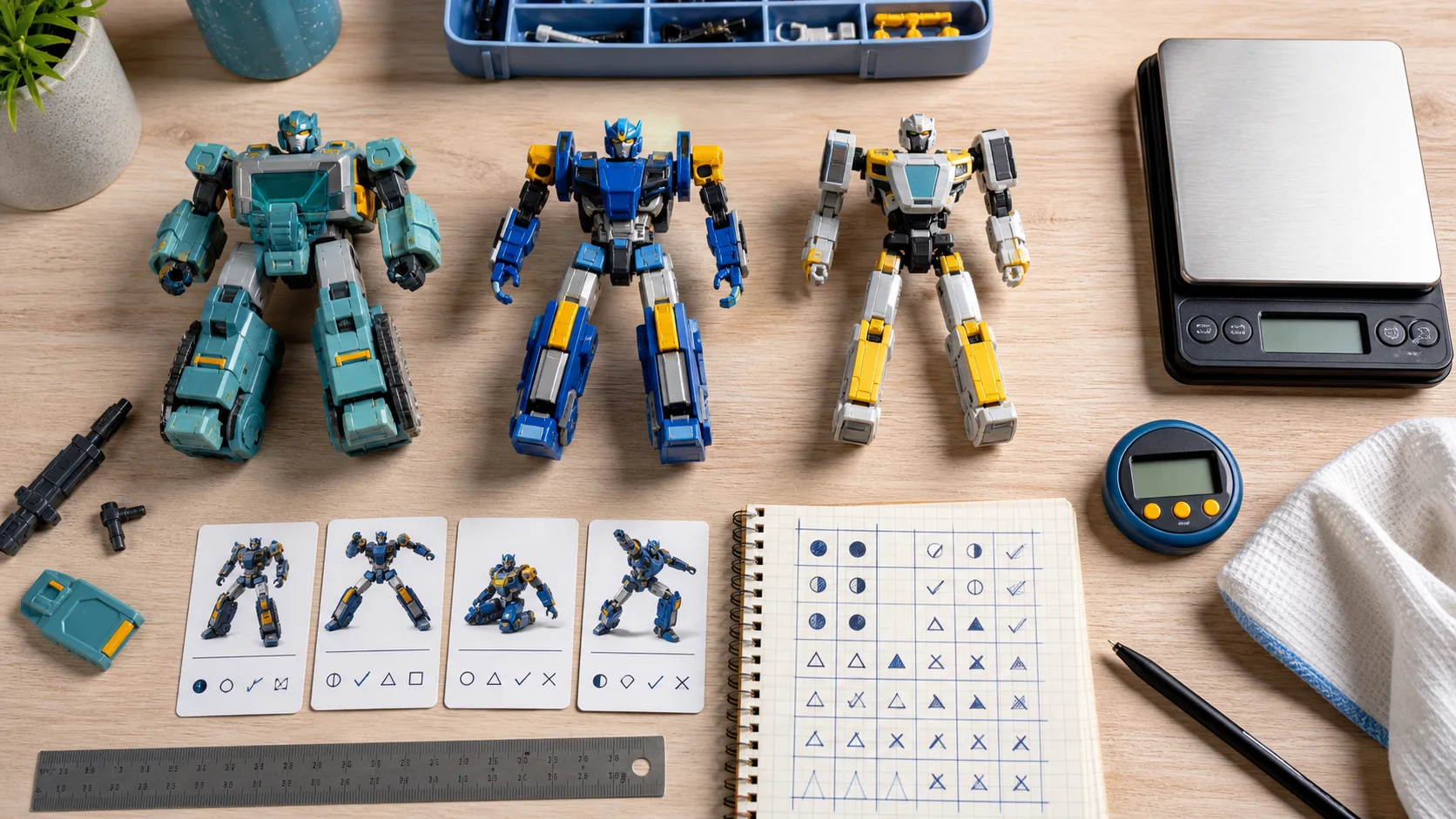
Some knockoff Transformers and unverified lookalikes can be fun display pieces for a fraction of the official price. The catch is consistency: loose joints, confusing instructions, missing parts, uneven paint and unclear licensing can turn a cheap transforming robot into poor value. We are putting three Chenghai-made samples through the same 20-cycle test before naming a winner. The full verdict is still coming, but this preview shows exactly what could make—or break—the bargain.
Test status — the boxes are being selected now. This page stays out of search results until all three physical toys complete the same protocol. We will not invent scores from seller photos. Bookmark this URL: the evidence, results and future video will be added here rather than split across duplicate pages.
Table of contents
Open Table of contents
- What Counts as a Knockoff Transformer?
- The Three Budget Transforming Robots We Tested
- How We Tested Build Quality and Play Value
- Packaging and Authenticity Clues
- Transformation Test: Speed, Fit and Frustration
- Paint, Joints and Durability After 20 Transformations
- Are Cheap Transforming Robots Safe for Children?
- Which Budget Robot Offers the Best Value?
- Are Knockoff Transformers Worth Buying?
- Frequently Asked Questions
What Counts as a Knockoff Transformer?
Not every robot that changes into a vehicle is fake. “Transforming robot” is a broad toy category, while collectors use third-party, KO, bootleg and counterfeit in different ways.
For this budget transforming robot review, we use three evidence labels:
- Verified licensed product: the rights holder or licensee confirms the exact product.
- Unverified lookalike: the design resembles a familiar character, but we cannot verify a license.
- Independent transforming robot: the toy uses the robot-to-vehicle idea with its own identity and design.
We reserve counterfeit for a product that appears to present itself as genuine through copied branding, packaging or product identity. Similar colors alone are not a legal verdict. See our third-party vs knockoff Transformers guide for the complete terminology check.
The Three Budget Transforming Robots We Tested
The comparison will use three toys priced from CNY 50 to CNY 150, close enough in size and complexity for a fair contest. Each package must name a manufacturer in Shantou’s Chenghai district. Approximate USD prices will use the exchange rate on the purchase date.
| Sample | Price paid | Manufacturer on package | The question it must answer |
|---|---|---|---|
| A: cheapest pick | Pending | To be verified | Can the lowest price survive repeated play? |
| B: middle pick | Pending | To be verified | Is this the value sweet spot? |
| C: most expensive | Pending | To be verified | Does extra money buy better joints and instructions? |
The suspense is not simply “which looks best?” One sample may win on transformation feel and lose on durability. Another may be less impressive in photos but far easier to live with.
Why are so many budget and lookalike toys made in Chenghai?
Chenghai is not synonymous with fake toys. It is a major legitimate toy-manufacturing cluster. The Shantou Industry and Information Technology Bureau describes a complete local chain covering raw materials, design, IP development, manufacturing and trade. The Shantou Commerce Bureau also highlights local mold development, production, warehousing and cross-border sales.
That density explains both sides of the market. A legitimate company can prototype quickly, source parts nearby and keep prices low. The same ready access to molds, components, packaging and online distribution can also make rapid imitation easier for an unauthorized operator. This is an inference from how the cluster works—not an accusation against Chenghai factories as a group. Local authorities and companies are also expanding IP services and enforcement; Shantou’s toy-industry legislation work specifically calls for faster IP support and coordinated action against infringement.
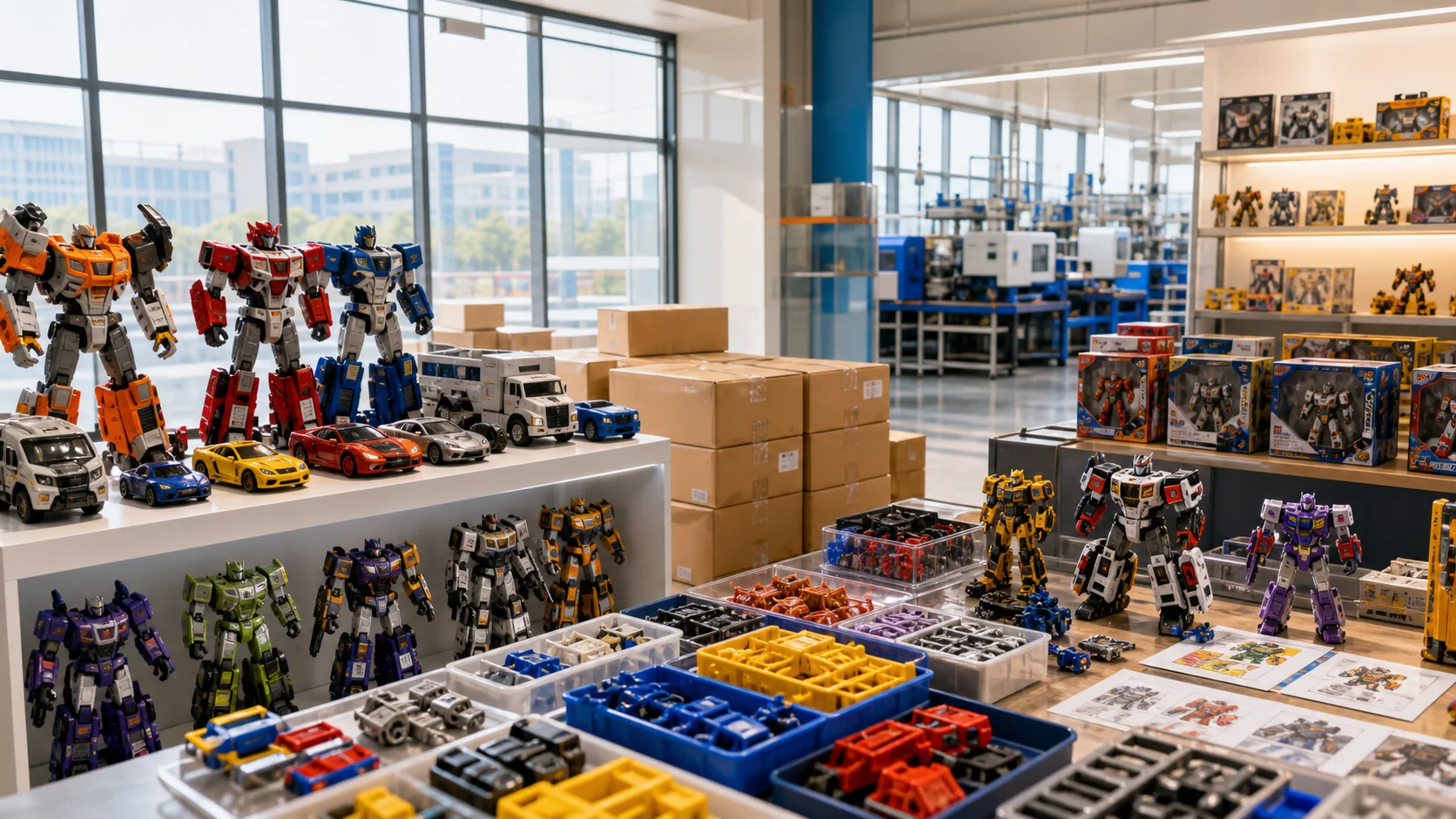 Editorial illustration: Chenghai’s supply-chain density can support both original products and fast imitation. It does not prove that any pictured or local product is counterfeit.
How We Tested Build Quality and Play Value
Every sample faces the same sequence: package inspection, weight and dimensions, a timed first transformation, 20 full transformation cycles, five poses, a dry-cloth paint check, an 80 cm carpet drop and a final joint inspection.
The important part is what happens between cycle one and cycle twenty. Does a stubborn tab become easier, or does it stop holding? Does a joint settle into a satisfying resistance, or slowly collapse under the toy’s own weight? Our complete transforming robot toy quality test makes the method repeatable.
Packaging and Authenticity Clues
Packaging tells us what the seller or manufacturer claims. It does not prove the toy is good.
We record the exact product name, manufacturer and address, model number, age grade, warnings, license statement, instructions and customer-service details. Then we compare the delivered toy with the listing.
Quick answer: can spelling mistakes identify a fake Transformer? They are a warning sign, not proof. Copied logos, a mismatched model number and a false official claim are stronger evidence. A plain box may hold an honest off-brand toy; polished packaging may still hide an unverified product.
Transformation Test: Speed, Fit and Frustration
The first transformation reveals the experience buyers actually receive. We time it with only the included instructions and count every reversal, panel collision, uncomfortable force point and unintended detached part.
Later cycles ask a more revealing question: once the novelty fades, is the toy satisfying enough to transform again?
| Measure | Sample A | Sample B | Sample C |
|---|---|---|---|
| First transformation time | Pending | Pending | Pending |
| Instruction reversals | Pending | Pending | Pending |
| Detached parts | Pending | Pending | Pending |
| Cycles completed | 0/20 | 0/20 | 0/20 |
Paint, Joints and Durability After 20 Transformations
Cheap transforming robot toys often look strongest on day one. Our before-and-after close-ups will focus on paint transfer, stress whitening, hinge movement, joint looseness, tab alignment and parts that no longer stay attached.
Five shared poses—neutral, walking, wide stance, one-arm reach and balanced action—must each stand unsupported for 30 seconds. A long articulation list earns nothing if the robot keeps falling over.
Are Cheap Transforming Robots Safe for Children?
Our home test cannot certify chemical or regulatory safety. It can reveal missing warnings, sharp-feeling damage, strong odors, loose parts and unclear age guidance. Those are reasons for caution, not laboratory findings.
For a child, traceable packaging and secure parts matter more than resemblance to a famous character. We will withhold a child recommendation if essential labeling cannot be verified, even when the figure displays well for an adult collector.
Which Budget Robot Offers the Best Value?
Value is not “the most plastic for the least money.” It is the useful experience left after frustration and failure risk are counted.
- Play value — 35%: transformation satisfaction, poseability and repeat appeal.
- Build quality — 25%: fit, finish, joints and observed durability.
- Ease of use — 20%: instructions, clarity and handling frustration.
- Price value — 20%: experience delivered for the real purchase price.
Before buying, use this 30-second value check: Is the manufacturer traceable? Are warnings and instructions present? Does the exact toy have credible hands-on reviews? Are returns possible if panels or joints fail? Four “yes” answers are worth more than a dramatic listing photo.
Are Knockoff Transformers Worth Buying?
Provisional answer: sometimes for an informed adult collector, rarely as a blind purchase, and never merely because the toy resembles an expensive character. The biggest possible upside is a fun transformation at a much lower price. The biggest risk is not cosmetic—it is inconsistent quality between products and even production batches.
Our final update will name the best overall, the best cheap pick and any sample that is not worth the risk. It will also separate display value from child play value. Until then, our rule is simple: pay for evidence, not resemblance.
Frequently Asked Questions
Is every third-party Transformer a knockoff?
No. Collector usage usually describes third-party figures as independently engineered but unofficial, while a knockoff copies much of an existing toy. Neither term proves quality.
Does KO mean knockoff?
Usually, yes. OSKO generally means oversized knockoff. The abbreviation describes market positioning, not whether a toy is durable or safe.
Why are knockoff transforming robots so cheap?
Possible reasons include dense local sourcing, simpler packaging, limited support, cheaper materials, fewer quality-control steps, no licensed IP cost or copied engineering. A low price does not reveal which explanation applies to a specific toy.
Can a cheap transforming robot be good value?
Yes, when the mechanism is enjoyable, parts stay attached, instructions work and the seller provides honest product information. A toy that costs half as much but breaks after a few transformations is not better value.
Will there be a video review?
Yes. After the written evidence is complete, our follow-up video will show the first transformations, timer, joint close-ups, 20-cycle changes and carpet-drop results. The video and VideoObject data will be added to this same page.
Leo Toy Hunt is independent and is not affiliated with Hasbro or Takara Tomy. Transformers is referenced only to describe the subject readers commonly search for.